Context-Aware Cognitive Reframing for Mental Wellbeing
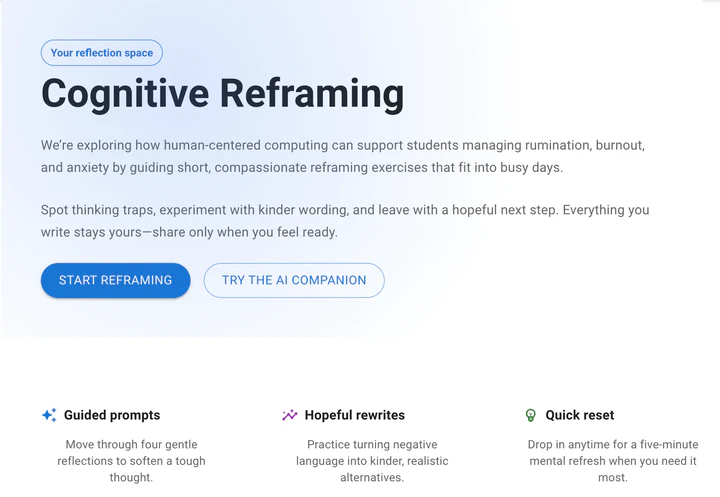
This project explores cognitive reframing for mental health using context awareness and multi‑modal sensing. Instead of relying on static journaling or manual prompts, the system detects moments of stress or negative self‑talk and delivers timely, personalized reframing cues in daily life. The goal is to help people notice unhelpful interpretations and shift toward more balanced, compassionate perspectives.
The approach is designed for real‑world conditions where:
- Emotional state fluctuates across situations and routines,
- Users may not recognize cognitive distortions in the moment,
- Minimal effort and interruption are essential for sustained engagement.
The core idea is to combine passive sensing (physiological and behavioral) with context inference (location, activity, social setting) to trigger micro‑interventions that fit the user’s current situation without feeling intrusive.
Context-Aware Reframing Pipeline
The system operates in three stages:
- Sensing and State Estimation: Wearable and mobile signals (e.g., heart rate variability, sleep, motion, screen activity) are used to infer stress, rumination, or affective shifts.
- Context Modeling: Location, time, calendar cues, and activity recognition provide situational context, enabling the system to choose an appropriate reframing strategy.
- Just-in-Time Reframing: Short, evidence‑based prompts are delivered via notifications or conversational interfaces to encourage alternative interpretations and adaptive coping.
Reframing Strategies and Personalization
The intervention library includes:
- Cognitive distortions labeling (e.g., catastrophizing, mind‑reading),
- Perspective shifting and compassionate self‑talk,
- Behavioral experiments and actionable next steps,
- Brief grounding and regulation techniques when arousal is high.
Personalization is driven by user preferences, historical response patterns, and contextual success rates. Over time, the system learns which prompts are most helpful in specific settings (e.g., work vs. home, solo vs. social).
Privacy, Safety, and Trust
Because mental health data is sensitive, the design emphasizes:
- On‑device processing where feasible,
- Transparent data controls and opt‑in sharing,
- Fail‑safe behavior that avoids escalating distress,
- Human‑centered language that feels supportive, not clinical.
Evaluation and Outcomes
The project evaluates effectiveness through:
- Short‑term reductions in self‑reported stress and rumination,
- Improved emotional recovery after adverse events,
- Engagement and perceived helpfulness across contexts,
- Qualitative feedback on tone, timing, and trust.